
How Change Programmes Fail
Why change forced from the top stalls, and what the AI era changes... and demands.

In 2011 the British government quietly dismantled the largest civilian IT programme the world had ever attempted. The NHS National Programme for IT set out in 2002 to give every patient a single electronic record; nine years and somewhere north of ten billion pounds later it was scrapped, and Parliament’s Public Accounts Committee called it one of the worst and costliest contracting failures the state had ever seen. Nothing about the ambition was wrong. The money was there, the suppliers were the biggest names in the industry, a prime minister launched it. What sank it was that clinicians experienced the whole thing as something done to them, and they were right.
Change programmes fail for a reason that has nothing to do with the plan or the budget. The people a change is done to feel its loss, the disruption, the relearning, the threat to status and hard-won mastery, more sharply than the people who ordered it feel the gain. So they resist, often quietly, and the change stalls, surviving only in a small pocket of early adopters who never reach the rest. Successful change runs the other way. It generates a sense of possibility, and the agency to act on it, among the people who do the work, and it spreads from the ground up rather than being pushed from the top down. AI sharpens both sides of this. It makes top-down failure more expensive than it has ever been, and it hands the bottom-up alternative real power.
1. The programmes that failed
The NHS programme is the cautionary tale everyone reaches for, but it is not an outlier. In 2018 Lidl walked away from a seven-year effort to replace its inventory system with SAP, writing off around five hundred million euros and reverting to the software it had started with. The retailer had built its operation around buying prices; the new system assumed retail prices; the people who ran the stores and the buying were asked to abandon the way they worked for a system designed elsewhere, and the organisation would not wear it. The technology was not the problem. Thousands of the world’s largest companies run the same software. What failed was the attempt to impose a new way of working on people who felt its cost long before they saw its benefit.
The aggregate numbers tell the same story. McKinsey has studied organisational transformations (some of them based on their own advice!) for over a decade and finds that fewer than a third succeed at both improving performance and holding the gain, a figure that has barely moved in all that time. The much-quoted claim that seventy per cent of change programmes fail has a shakier pedigree than the people quoting it admit, tracing back through a chain of citations to a single estimate rather than a study; the honest version is no less sobering. Most transformations fall short, the rate does not improve with practice, and senior leaders are reliably more convinced than everyone else that the message has landed. The people who ordered the change believe it has happened. The people who have to live with it know it has not.
2. Why the loss beats the gain
Sit with the person a change is done to and the failure stops being mysterious. The loss they face is concrete, immediate and personal: a routine they were good at, the standing that came with knowing the old system, a month of feeling incompetent while they relearn their job. The gain is abstract, deferred and usually someone else’s: a number on a slide, a benefit that lands two levels up. Set a certain, present, personal loss against an uncertain, future, second-hand gain, and resistance is not irrational. It is the correct answer to the incentives as the person actually experiences them.
This is why imposed change stalls in the same place every time. It survives among the few whose gain genuinely does outweigh their loss, the early adopters, the ambitious, the ones the new way happens to suit, and it stops at the edge of that group. Everyone beyond it has quietly done the sum and found the change wanting. A mandate from above does not change the sum, because the mandate is not the thing being weighed. What is being weighed is what each person stands to lose against what they can see themselves gaining, and for most of the organisation the answer is no.
3. How change actually spreads
If imposed change dies on that asymmetry, change that works has to turn the sum around for the people on the ground, and it does so as a cycle rather than a campaign. Four things decide whether a new way of working takes. There is the event: the moment a team does something the old rules called impossible and sees it work. There is the language: the words people reach for once that has happened, because what counts as possible has visibly changed. There is the structure: the informal way early users organise around the new thing and push it further. And there is agency: the mandate that structure earns, grounded in what everyone can now see works. We call this positive, generative cycle, ELSA.
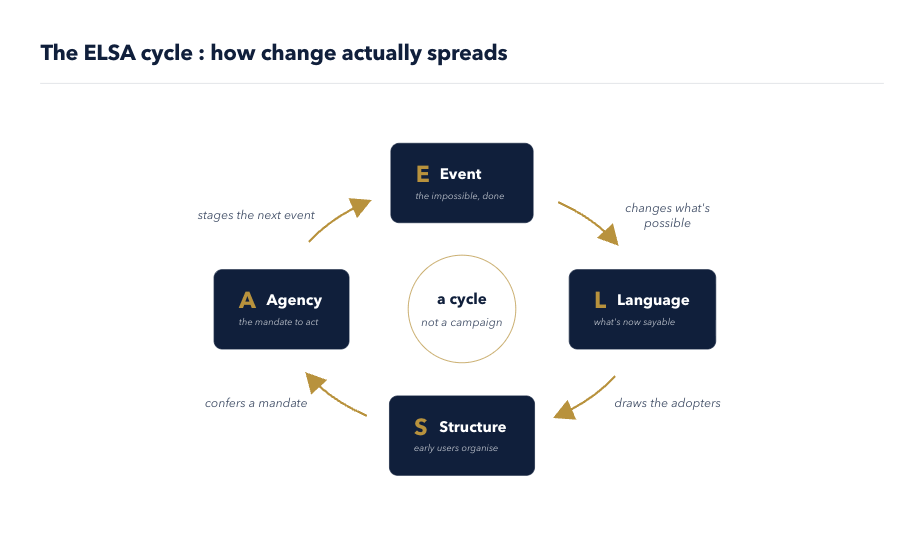
Put in motion, these become a flywheel. An event changes what people say is possible. That shift draws the early adopters, who gather around the new thing and extend it. Their gathering hardens into structure, and structure confers agency, the standing to act on what plainly works. Agency then makes the next event easier to find and to stage, and the wheel turns again. Event, language, structure, agency, another event. Crucially, the gain is no longer abstract and two levels up; it is visible, local, and owned by the people doing the work, which is exactly why they stop resisting and start pulling. A programme tries to install all four forces at once, from outside, by decree, which is why it stalls before the wheel has turned even once.
4. Why AI raises the cost of failure
None of this is new. What is new is the price. Layering artificial intelligence onto an organisation raises the stakes of getting change wrong, because AI amplifies whatever it lands on. RAND’s 2024 study of why AI projects fail found that more than eighty per cent of them do, roughly twice the failure rate of technology projects without AI, and that the leading cause is not the algorithms but a basic disagreement about what problem the thing is meant to solve. S&P Global found the share of companies abandoning most of their AI initiatives before production climbed from seventeen per cent in 2024 to forty-two per cent a year later.
Automating a change the organisation has quietly rejected does not win the argument; it makes the rejected thing run faster and cost more, with a model in the middle optimised for a target nobody on the ground agreed. A firm could once absorb a failed programme every few years as a cost of doing business. It cannot absorb the same rate of failure when each one also strands an AI investment and the competitor whose people actually adopted is pulling away. The old tolerance for change that never takes was a luxury of a slower era. It has gone.
5. The intelligent pizza team
So where does a real event come from? From a small team on the ground with the room to build something and the ownership to keep the gain. Twenty-odd years ago Jeff Bezos gave Amazon a rule: no team should be larger than two pizzas can feed. The point was never lunch. A small team that owns one thing end to end, and sees the benefit of its own work, escapes the loss-against-gain asymmetry that kills imposed change, because the people bearing the change and the people gaining from it are the same people.
The historic limit on such a team was capability. A group of eight could only hold so much before the work had to be split out to specialists elsewhere and ownership fractured. AI lifts that ceiling. When a small team can call on models that carry the routine load, retrieve the expertise it lacks, and run the checks that once needed a separate function, it can own a whole outcome by itself, and it can ship the thing the old rules called impossible. Call it an intelligent pizza team: small enough to share one language, capable enough to own the whole result, and therefore able to produce the first event that starts the wheel turning. That is where change is made, not managed.
6. Grow change from the ground up
The move the AI era rewards is not a bigger change programme; it is the opposite. Rather than decree a change from the top and push it across an organisation that has already priced its loss, you create the conditions for change to be generated from below: a small team, real ownership, the tools to build, and the licence to prove the impossible possible. Then you let the wheel turn. The first team’s event changes what the next team believes it can do, and the change spreads the only way change ever really spreads, by invitation rather than instruction.
This does not let leadership off the hook; it changes the job. The work is no longer to announce the change and enforce it, but to choose the first team well, hand it a problem hard enough that success is undeniable, give it the tools and the air cover, and then protect the wheel while it turns. When change is generated by the people who do the work, the loss and the gain sit with the same people, so there is little left to resist. Possibility and agency are produced on the ground, where they are believed, rather than proclaimed from a stage, where they are not. That is why programmes fail and teams succeed. A programme fights the sum that every affected person is quietly doing. A team changes the sum.
Try this
An organisational prompt is a small provocation you act on this week, not a theory to file away. Here is one: what single prevailing ‘truth’ that limits value in your organisation could you overturn? The kind everyone repeats as if it were a law of nature, “we can’t get anything into production in less than a week,” “nothing moves without three sign-offs.” Call it out, then hand one small team the tools and the licence to prove it wrong this month. Let the rest of the organisation watch what happens.
Further Reading
The dismantling of the NHS National Programme for IT, IEEE Spectrum
Lidl’s €500m SAP write-off, Computer Weekly
Why do most transformations fail, McKinsey
The Root Causes of Failure for AI Projects, RAND
Amazon’s two-pizza teams, AWS Executive Insights